How to Start IIT JEE Preparation after Class 10th?


IIT JEE preparation is a commitment that requires patience, hard work, and intelligence. They are considered among the most challenging entrance examinations for school graduates. As a result, many students start early on to increase their chances of securing admissions to the coveted IITs.
No straightforward, universe formula is available that tells you when the right time for IIT JEE preparation is. You will find students cracking the exam in the first year of their preparation as well as students managing to qualify for the exam after a series of attempts. However, it is recommended that the preparation should begin, at least on an elementary level, after Class 10th.
IIT JEE Preparation after Class 10th
Preparing for IIT JEE right after Class 10th is one of the most decisive academic choices a student can make. This phase marks the transition from school-level learning to competitive, concept-driven preparation required for India’s toughest engineering entrance exam.
Starting early gives students nearly 700–750 days before JEE Advanced, which is enough time to build strong fundamentals, practice extensively, and revise multiple times—provided the approach is systematic and disciplined.
That said, multiple factors are involved in deciding whether or not to prepare for the IIT JEE after Class 10th. In this guide, I will give you an overview of what it takes to begin preparation after Class 10th.
1. You Should Have Eyes Set On The Goal
The decision to pick up preparatory material at Class 10th requires a lot of thinking. Generally, students start the cycle from Class 11th. However, the basics taught in both Classes 10th and 12th are relevant for IIT JEE examination.
Two years of preparation is long and can be tiresome. Should you have any doubts about your future, you should delay preparation until you are mentally ready for the endeavour.
If you are certain that IIT JEE is what your target is, then you will have to sit down, alone or with family & mentors, and define your aspirations, target rank, choice of IIT or engineering institution in general, and how you will manage preparation for both boards and IIT JEE.
2. Research well About IITs and Other Engineering Institutions
It is important to elaborate on the first point on setting goals. One of the major expectations from students is to decide where they want to study and which engineering stream to choose.
Of course, you still have time to change your options, but you must have a fair idea of what might appeal to your academic and professional appetite in the future. Thus, to achieve this, you will have to do your research.
Usually, students have an IIT/college or engineering stream in mind. Whichever is your choice, you must avoid crowd mentality. If, for instance, your cousins are interested in aerospace engineering, you need not pick just for the sake of it. Similarly, a friend of yours might have made it to IIT Delhi last year but that does not mean you should be there too.
While doing your research, keep an eye out for the past placement records of institutions, the presence of a strong alumni network, and the administrative ecosystem.
When it comes to streams, you must self-assess, read about the various streams available, and enquire about the career opportunities in every one of them. Options available include civil engineering, computer science, chemical engineering, and aerospace engineering.
3. Consider Switching your Board for IIT JEE Preparation
While it is not mandatory, you should consider switching your school board. The Central Board of Secondary Education (CBSE) is the most preferred option, as the IIT JEE syllabus is aligned with CBSE’s.
The CBSE prescribes the textbooks published by the National Council of Educational Research and Training (NCERT). These books are foundational modules for the IIT JEE Main examination which features many questions from these books. If you are studying under the right board, your preparation can be streamlined and organized.
Nonetheless, you don’t need to switch boards if you are comfortable with your present one. You should, however, consider enquiring with your school teachers whether and how they will allow simultaneous preparation.
4. Choose the Right IIT Coaching Institute
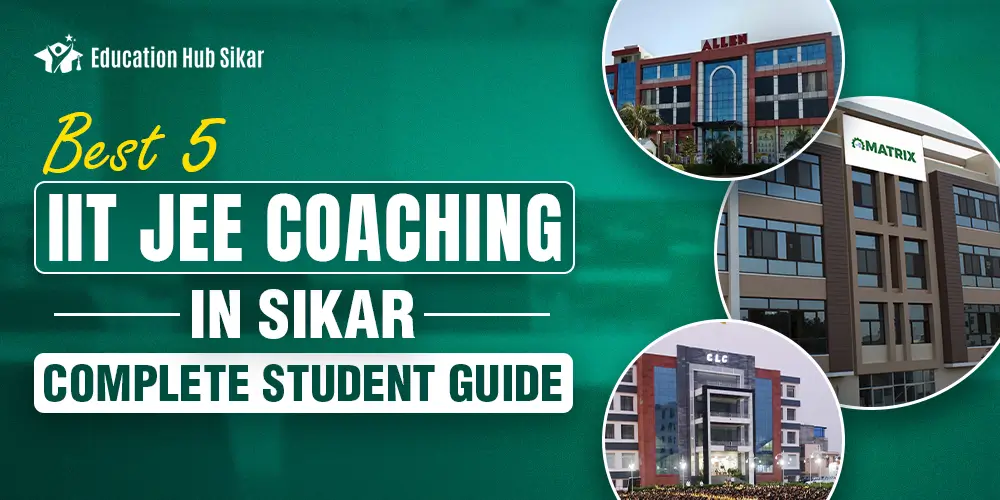
For an orderly IIT JEE preparation, you need a good and reliable coaching institute. You will many well-reputed, result-oriented coaching institutes in Sikar–many of them are, in fact, branches of national-level coaching institutes. To name a few, there is Allen Sikar, Unacademy, and Aakash. Other notable institutes include Matrix and Gurukripya Career Institute.
With options aplenty, the real question is how to choose the right IIT JEE coaching institute in Sikar (or outside). The most important considerations for making an informed decision about it include the track record, student feedback, infrastructure, student support services, fee structure, quality of study materials, and the qualification & experience of faculty members.
You can find a list of top IIT JEE Coaching Institute (or how to choose the right such institute) in Sikar, if interested.
5. Create a Timetable
Once you have figured out what your goals are, you need to get down and prepare a study schedule.
Class 10th boards should be done by the time you join a coaching institute or begin with your IIT JEE preparation. The pressure for the Class 12th Board will gradually grow on you, which means you will have to ensure adequate distribution of time.
In the next two years, you will have to practice your basics, attend hours of coaching classes in addition to school hours, and engage in extra-curriculars. Make sure you consult your faculty to know how to allocate time; for starters, allocate adequate hours for each subject, spend at least a few hours on practising IIT JEE mock tests and previous years’ question papers, and dedicate a reasonable number of leisure hours.
One piece of advice: do not make a rigid schedule. Overconsumption of information without sufficient breaks and diversity can result in stagnation and weak retention.
6. Online Resources are Very Highly useful in IIT JEE Preparation
Post-COVID-19, the face of education has changed dramatically. Technology was used before, however, the spurt in digitalization during the pandemic has resulted in an explosion of IIT JEE study materials online, whether in the form of reading materials or online lectures.
Since you have just graduated from Class 10th, you should navigate all possible avenues of knowledge. While your coaching institute in Sikar (or outside) will be your main form of preparation, several online reading materials and online videos (from coaching institutes and independent instructors) enhance your learning experience.
For example, Vedantu JEE Made Ejee runs a playlist of the IIT JEE Main Mock test where the instructors practice mock tests with the JEE aspirants online. You can also check Unacademy’s website where content is replete with materials on IIT JEE core subjects. For example, JEE aspirants can read about Adjoint of Matrix on its website here
7. Keep Yourself Updated with IIT JEE Developments
One of the most important things about IIT JEE preparation is how well you understand the syllabus. It is your responsibility to know by heart everything there is about the syllabus of each subject. Unless you know these details you will not be able to streamline your goals and create a workable schedule.
Moreover, IIT JEE Main and Advanced happen to change concerning their exam pattern, their registration rules, and other issues. While your coaching institute will keep up updated, you must keep a watch on these developments as you prepare. One way to ensure that is to visit the official IIT JEE website regularly and keep track of notifications; here is a link to the website for the JEE Main, and JEE Advanced deals with JEE Advanced.
Understanding the IIT JEE Journey
The IIT JEE journey is not just about cracking an exam; it is about developing analytical thinking, patience, and problem-solving skills. Many students fail not due to lack of intelligence but due to poor planning and unrealistic expectations.
Knowing the exam structure, competition level, and preparation demand helps students mentally prepare for the long-term commitment required after Class 10th.
What Is IIT JEE and Why Is It Important?
IIT JEE is the national-level entrance exam for admission into IITs, NITs, IIITs, and GFTIs. Every year, around 11–12 lakh students appear for JEE Main, but only about 2.5 lakh qualify for JEE Advanced.
Securing a good rank in IIT JEE opens doors to top engineering institutes, better placement opportunities, higher starting salaries, and global academic exposure, making it one of the most sought-after exams in India.
Difference Between JEE Main and JEE Advanced
JEE Main is the qualifying exam that determines eligibility for JEE Advanced and admission into NITs, IIITs, and other central institutions. It focuses more on speed, accuracy, and NCERT-based concepts.
JEE Advanced, on the other hand, tests deep conceptual understanding, multi-step problem-solving, and application skills. Only the top ~2.5 lakh JEE Main rank holders can appear for it.
| Parameter | JEE Main | JEE Advanced |
|---|---|---|
| Purpose of Exam | Screening exam for admission to NITs, IIITs, CFTIs and qualification for JEE Advanced | Final exam for admission into IITs |
| Conducting Authority | National Testing Agency (NTA) | IITs (on a rotational basis) |
| Level of Difficulty | Moderate to Difficult | Very Difficult (Conceptually Advanced) |
| Number of Attempts | 6 attempts (3 consecutive years, 2 attempts per year) | 2 attempts (2 consecutive years) |
| Eligibility | Open to all students meeting age and qualification criteria | Only top ~2.5 lakh JEE Main qualified candidates |
| Mode of Examination | Computer-Based Test (Online) | Computer-Based Test (Online) |
| Number of Papers | Single paper per attempt | Two compulsory papers (Paper 1 & Paper 2) |
| Question Type | MCQs & Numerical Value Based Questions | MCQs, Numerical, Integer & Match-the-Following |
| Syllabus | Based on NCERT Class 11 & 12 | Same syllabus but deeper conceptual application |
| Focus of Questions | Speed, accuracy & basic concepts | Analytical thinking, problem-solving & depth |
| Marking Scheme | Mostly fixed marking, limited negative marking | Variable marking, partial & negative marking |
| Colleges Through Exam | NITs, IIITs, GFTIs, some state colleges | IITs only |
| Cut-off Nature | Higher cut-offs for top NITs | Rank-based admission, no fixed cut-off marks |
| Competition Level | Very High (12+ lakh candidates annually) | Extremely High (Top 2.5 lakh compete) |
| Exam Frequency | Twice every year | Once every year |
| Rank Usage | Used for college admission & Advanced eligibility | Used only for IIT admissions |
Choosing the Right Path After Class 10th
Selecting the correct academic path after Class 10th directly impacts IIT JEE preparation. Students must align their school education with competitive exam requirements.
A wrong choice at this stage often leads to syllabus overload, stress, and imbalance between boards and JEE preparation.
Which Stream to Choose for IIT JEE Preparation?
Students must opt for Science stream with Physics, Chemistry, and Mathematics (PCM) in Class 11. These subjects form the complete syllabus of IIT JEE.
Without PCM, students become ineligible for the exam as this is an important aspect of JEE Main eligibility criteria. Early exposure to PCM also helps students adjust to higher-level numerical and theoretical complexity.
Building a Strong Academic Foundation
A strong foundation in Class 11 concepts determines success in Class 12 and final JEE performance. Most JEE dropouts struggle because they ignore basics early.
Conceptual clarity at this stage reduces pressure later and allows students to handle advanced problems with confidence.
Importance of NCERT Books for IIT JEE
NCERT books are the backbone of IIT JEE preparation, especially for Chemistry, where nearly 90% of questions are directly or indirectly NCERT-based.
Reading NCERT thoroughly helps students understand definitions, derivations, and examples that form the base for advanced-level questions.
How to Strengthen Class 11 Basics Early?
Class 11 topics like Mechanics, Mole Concept, and Algebra are foundational. Weakness here reflects in Class 12 topics such as Electrodynamics and Calculus.
Students should focus on concept-building, daily revision, and gradual problem-solving rather than rushing to complete the syllabus.
Role of Coaching after 10th in IIT JEE Preparation
While self-study is crucial, structured coaching provides direction, discipline, and expert guidance that most beginners need. Coaching is not mandatory, but it significantly increases success probability by offering systematic content, doubt resolution, and peer competition.
Coaching helps students avoid common mistakes, follow a realistic schedule, and measure progress through regular tests. Data from major institutes shows that over 85% of IIT selections come from coached students, indicating the advantage of guided preparation.
How to Choose the Best IIT JEE Coaching Institute after 10th
A good coaching institute should have experienced faculty, consistent results, limited batch size, and regular testing systems. Students should also consider study environment, location, past results, and student feedback before enrolling. Best IIT JEE Coaching Institute will consider all factors which will lead to admission to IITs for top engineering courses.
This is where Matrix Academy excels, as they have Momentum batch which is a 2-Year Integrated Foundation Classroom Program for JEE Main & Advanced for 10th to 11th Moving Students. You can also book a counselling session by calling at +91 1572 241911.
Creating a 2-Year IIT JEE Study Plan
IIT JEE preparation requires long-term planning, not short-term bursts of study. A 2-year roadmap ensures syllabus completion with multiple revisions.
Breaking the preparation into Class 11 and Class 12 phases makes learning more manageable and effective.
Class 11 Study Strategy for IIT JEE Aspirants
Class 11 should focus on understanding concepts deeply rather than solving too many questions. Topics like Laws of Motion and Chemical Bonding must be mastered.
Students should revise weekly and avoid backlog, as unresolved doubts in Class 11 become major obstacles later.
Class 12 Study Strategy for IIT JEE Aspirants
Class 12 requires balancing board exams and JEE preparation. Since 75% board criteria is mandatory, equal importance must be given to both.
Advanced problem-solving, mock tests, and revision cycles become more important during this year.
Daily Study Routine for IIT JEE Beginners
A disciplined daily routine builds consistency, which is more important than studying long hours occasionally. Students should aim for balanced schedules that include learning, practice, and rest.
Time management is critical when juggling multiple commitments. Prioritizing weak subjects helps improve overall performance. Using planners, weekly targets, and regular reviews keeps preparation on track.
Ideal Daily Time Table After Class 10th
| Activity | Time |
|---|---|
| Coaching/School | 6–7 hrs |
| Self-study | 4–5 hrs |
| Practice & Revision | 2 hrs |
| Sleep & Breaks | 7 hrs |
A realistic routine improves productivity and prevents burnout.
Best Books and Study Materials for IIT JEE
Choosing limited but high-quality resources prevents confusion and saves time. Students should focus on mastering selected books instead of collecting many. These books cover both conceptual and competitive-level requirements. Many students buy too many books and fail to complete any properly. Switching materials frequently disrupts learning continuity and creates unnecessary stress.
Subject-Wise Book Recommendations
- Physics: NCERT, H.C. Verma
- Chemistry: NCERT, OP Tandon, N Awasthi
- Mathematics: NCERT, R.D. Sharma, Cengage
Importance of Practice and Mock Tests
Practice converts theory into application, which is the core of IIT JEE. Mock tests simulate exam pressure and help improve speed and accuracy. Students should start JEE-level questions once basic concepts are clear, usually within 2–3 weeks of starting a chapter. Gradual difficulty progression prevents frustration and builds confidence.
Mock tests identify weak areas, improve time management, and reduce exam anxiety. Students who take 50+ full-length mocks generally perform better in the actual exam.
Developing the Right Mindset for IIT JEE
Mental strength is as important as academic preparation in a long journey like IIT JEE. Students focusing on logic and reasoning adapt better to unpredictable paper patterns. A positive mindset helps students overcome failures and stay motivated. IIT JEE rewards understanding, not memorization. Questions often combine multiple concepts in unfamiliar ways.
Consistency beats intensity. Studying daily, even for fewer hours, yields better results than irregular long sessions. Celebrating small achievements keeps motivation high.
Health, Stress Management, and Discipline
Ignoring health leads to burnout, poor concentration, and reduced performance. Balanced routines help sustain long-term preparation. Stress is common due to competition and expectations. Proper planning reduces last-minute pressure. Talking to mentors and taking short breaks helps maintain emotional balance.
Scientific studies show that 7–8 hours of sleep improves memory retention and problem-solving skills. Light exercise or walking boosts focus and reduces fatigue.
Final Tips to Start IIT JEE Preparation Successfully
The right start after Class 10th sets the tone for the next two years. Small disciplined actions lead to big results over time. Students starting early get more revision cycles and better concept clarity.
Early starters statistically have a 2–3x higher success rate compared to late beginners.
Do’s and Don’ts After Class 10th
Do’s
- Focus on fundamentals
- Revise regularly
- Ask doubts early
Don’ts
- Compare with others
- Ignore Class 11
- Overload study materials
FAQs
The ideal time to start IIT JEE preparation is immediately after Class 10th results. Beginning early gives students enough time to build strong fundamentals in Physics, Chemistry, and Mathematics without academic pressure. It also allows better time management across Class 11 and 12.
Yes, you can start IIT JEE preparation without coaching if you have strong self-discipline, quality study material, and a clear study plan. However, coaching helps with structured learning, expert guidance, regular testing, and peer competition, which benefits most students.
After Class 10th, students should aim for 4–6 focused study hours daily in Class 11, gradually increasing to 6 to 8 hours in Class 12. Consistency matters more than long study hours, especially in the initial phase.
Students should start with basic concepts of Physics, Chemistry, and Mathematics from Class 11 syllabus. Topics like Motion, Sets, Mole Concept, and Trigonometry help in building a strong foundation for advanced concepts later.
NCERT books are essential but not sufficient alone. They help build conceptual clarity, especially in Chemistry and Mathematics. Students must also use reference books and practice advanced-level problems designed specifically for IIT JEE.
Also Read: